HELLO MY DEAR

i’m someone who speaks little and tires fast
i like drinking wine with helva
i’ve never prayed until now
i love my mother and Allah a lot
my mother also loves Allah a lot
it’s a bit of a thing in our family
to love Allah and cats a lot
[…]
and one day you won’t even realise
my body rising towards the sun and masculinity
will fall off your hands your hands and
one day you will certainly
end up loving zeki müren
(do love zeki müren)1
In this poem he wrote in the 1960s, Arkadaş Z. Özger encourages his readers to love Zeki Müren (1931-1996), a singer and composer also known as the “Sun of Art”. This poem, rediscovered in recent years, has become a sort of queer anthem in Turkey. In fact, although he never made any public declarations about his sexuality, Zeki Müren is considered a queer icon. As for Arkadaş, his queerness was kept silent for a long time. Even in his time’s activist circles which claimed to be progressive, traditional hetero-masculinity was the norm. Through his verses, then, Arkadaş expressed what others did not want to hear. However, Arkadaş’ encouragement was far from being necessary. Zeki Müren was, and still is, one of Turkey’s favorite public figures. He was mourned at a state funeral attended by around 90 000 people.
The young musician’s voice was heard for the first time in 1951, when he was just twenty years old, on the TRT (Turkey’s national radio). As the TRT was only broadcasted in the Marmara region, it’s only once he started recording albums that Zeki Müren’s voice resonated across the country, and beyond. At that time, the Republic of Turkey2, in an attempt of “modernisation”, was still striving to cut ties with all Eastern influences (from the outside as well as from within). The radio was seen as a useful tool by the government as it allowed to broadcast a brand new “European” identity as well as a new culture, language and music across the country. However, these novelties didn’t particularly interest the Eastern population of the country who would simply switch to the Egyptian radio instead3. Back then, the voice of Zeki Müren could be heard on the BBC and Voice of America which broadcasted programs in Turkish as well as the radios of Tehran, Damascus, Belgrade and Egypt. An obituary written about the musician says : “I grew up in Kilis [at the Syrian border]. Next to the Great Mosque, there was the “Little Market”, that’s where our house was. At the start of the 1950s, not many people had radios at home. However, most of us at the “Little Market” did have one. On market days, we would open the houses and passersby could hear the radio. People listened to Radio Damascus because Radio Ankara’s signal was weak. […] They always played Zeki Müren. Everyone who came to Kilis brought Zeki Müren records with them. These were the most precious gifts one could receive at the time. There were two big names around. One only had to mention the Egyptian Umm Kulthum or Zeki Müren from Turkey. People were delighted to hear them.“4
One day, Zeki Müren, whose popularity in the region was growing by the day, found out that Umm Kulthum (The Planet of the East) had not only heard of him, she also enjoyed his music. “The person who I admire the most enjoys my music, what a joy!” he exclaimed. We can imagine his happiness in 1967 upon receiving a letter written by the diva herself, in which she invited him to perform in Egypt. “We would be delighted to hear you perform in Egypt. We’re asking for three concerts over three evening. You will be Egypt’s guest of honour.” However, Zeki Müren wasn’t the young man singing at the TRT anymore, he was a diva in his own right. Thus, he responded : “I will only do one concert, in Cairo, on a raft floating on the Nile. My 50-piece orchestra will be on this raft as well, by my side. The audience will be seated on the shore. The raft will float, adorned with Turkish flags, flowers and lights…“5
This concert never took place.
At that time, the Republic of Turkey was still trying to distance itself from all oriental influences, as well as from the multicultural and multilingual identity of the Ottoman Empire. However, the resurgence of arabesk music couldn’t be prevented. It slowly took over the soundscape of the country, especially of the bigger cities where young people from the East migrated in order to find work. Zeki Müren believed that music should free itself from the elitist constraints of the “modern world” and instead, address people directly. He also embraced this arabesk style of music. In 1980, he released an album which mixed Turkish Classical Music (Türk Sanat Müziği) and Arabesk. This album, and more particularly the song titled Kahır Mektubu [The Letter of Despair] came as a surprise to his listeners. It’s a long format (29 minutes) inspired by the music of Umm Kulthum. In fact, it was composed by the producer and mentor of Müren who is said to have been inspired by an Umm Kulthum song (probably Inta Omri) he heard at an Arab café in Paris6.
It wasn’t long before Zeki Müren, who started his career as an anonymous voice at the national radio, became known as an icon. First, through his roles in movies (where he often played a musician named “Zeki”), then through his innovative live performances . Müren started performing in ‘gazinos’ in 1956. These venues, which don’t exist anymore, had the particularity of gathering people from various categories of the society. There, one could encounter members of parliament as well as shopkeepers, men as well as women, people of all ages, young single people and families. For Müren, it was extremely important to present a true spectacle, an unforgettable experience to his audience. “If my audience simply wanted to hear my voice, they would listen to my records. If they wake up early, leave their house and come to the gazino, I must present them with something satisfying.“7 Each evening, he would address his audience with utter respect and appreciation. “My veneraaaable, respectable, honourable, deaaar audience… As always, I present to you all my gratitude and appreciation, I urge you to accept it, ladies and gentlemen. […] As I repeat my gratitude and appreciation for everything, really, everything, for these years, my fame, every breath I take. I also thank you for this evening and these beautiful, elegant flowers which make me so happy.” These performances are what earned him the title of Sun of Art (Sanat Güneşi).
His performances took yet another turn after the trip he took to the U.S. in 1963. “I’m on my way to teach Alaturka to Frank Sinatra!” he announced to the journalists who were seeing him off at the airport8. His trip was cut short as Kennedy was murdered on the 26th of November. However, he had enough time to familiarise himself with the local television, visit Marilyn Monroe’s tomb were he recited an Al-Fatiha for her soul (see photo), meet Mickey Mouse and watch Liberace (The Glitter-Man) perform in Las Vegas.
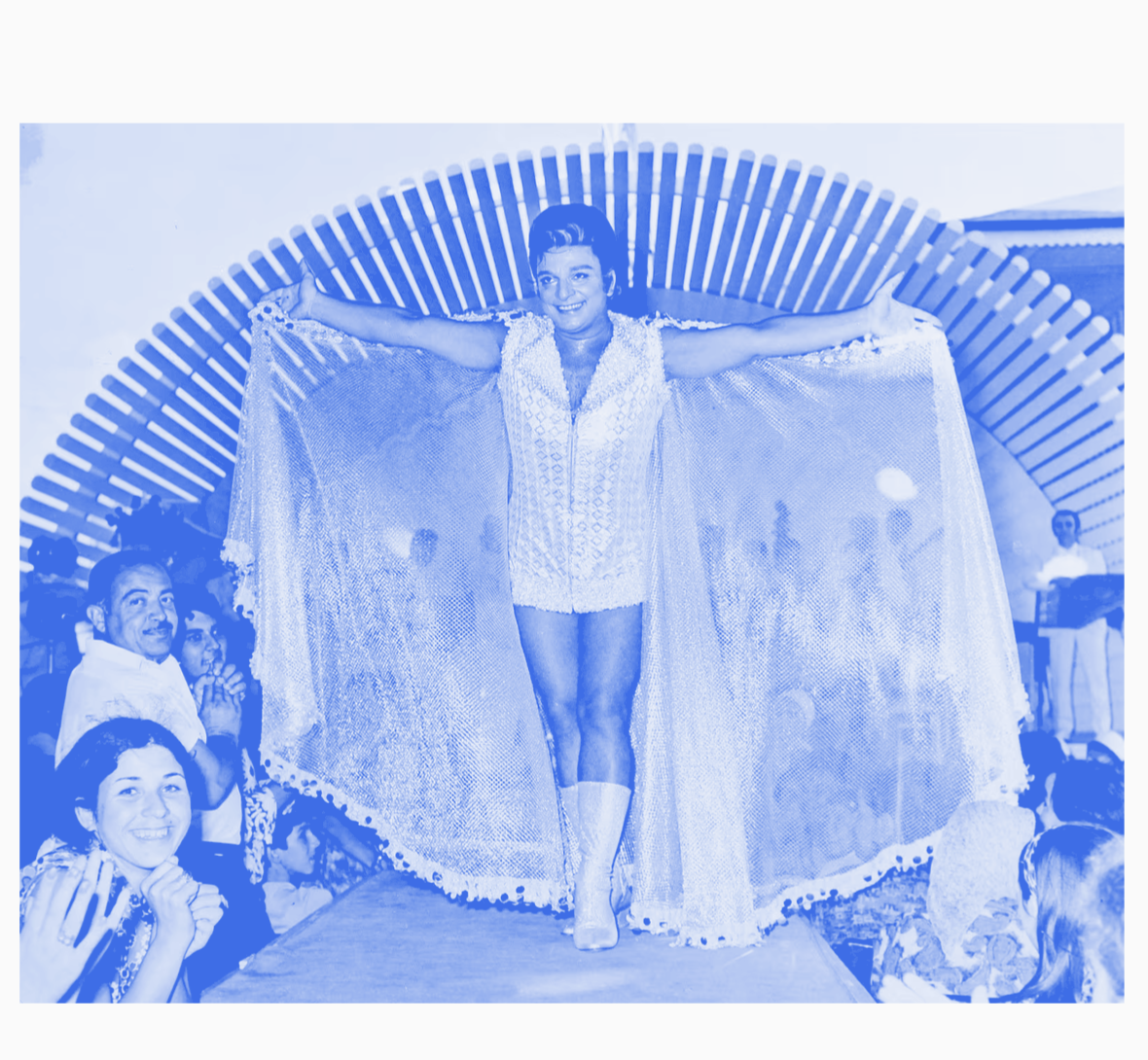
When he returned to Turkey, he designed a T-shaped stage and a custom microphone allowing him to wander freely on that stage. This would bring closer to his audience. This stage, however, was raised. Zeki Müren got closer to his audience while remaining inaccessible. As he had a background in fashion design, the musician created his own costumes as well as his orchestra’s from his first ever performance. It seems as though his encounter with Liberace gave him the desire (and perhaps, the courage?) to go even further. His costumes became brighter and louder. Yet, although the physical resemblance between the two artists was glaring, Zeki Müren didn’t quite appreciate the comparison, or at least the idea that he tried to imitate him. “For instance, they compare Liberace to myself [He doesn’t say “They compare me to Liberace”!] in terms of our styles. I don’t agree: what I wore in 56, he did years later in 60. Our souls might be in accordance, but I did not imitate him after seeing him.“9
The artist regularly put an emphasis on the fact that his endeavours were never motivated by money. Though he wasn’t (only) motivated by money, Zeki Müren was willing to do anything to achieve popularity. His performances, and his public persona, always oscillated between total expression of himself and restraint. He never addressed political matters publicly. The only time he took part in such conversations was in 1968 when he announced his candidacy for the general elections. His statement, however, was far from being divisive: “The name of the party has been decided, it will be The Artists’ Party. I will not partake in the battle between left and right within the parliament. Since the parliament was created, no one has represented the arts, no one has protected the artists’ rights or well-being. This is exactly what I will do. I only want to enter politics in order to represent artists.“10
When he was asked which football team he cheers for, he replied “The national team.” This idea of neutrality and seeking popularity, however, is paradoxical when we take into consideration the fact that, during his career, Zeki Müren has taken risks that no one else has dared to before him. When he was asked about the skirt he wore on stage, he simply replied that Julius Caesar wore skirts too. He got up on stage wearing make-up, skirts, high heels, nail polish and everyone not only accepted him as he was, they admired him. Things that were not allowed, violently repressed within society, were completely tolerated when Zeki Müren did them on stage. “Society, stuck between tradition and modernity, has glorified Zeki Müren as the creator of a fantasy universe.”11
This ‘indulgence’ showed by audience to Zeki Müren might be the expression of a feeling of gratitude. In fact, this artist trained by some of the most important names of the Türk Sanat Müziği, very quickly rejected the idea that this music should only address an elite and that it couldn’t incorporate oriental influences. Maybe this was a symptom of Müren’s need for popularity, but he did consider it his duty to include each and everyone in his audience. In return, he was adopted by an entire nation.
A century after its creation, the Republic of Turkey is still looking to build its own identity. It categorically refuses its own heritage and instead, invents a new one that changes throughout the years and regimes. It was founded on the model of the French Republic which, on the contrary, is still holding on to an identity which is prevented from evolving or transforming. There, culture and identity are considered as unchangeable and impermeable. The Planet of the East and The Glitter-man both played an equal part in making Zeki Müren The Sun of Art. It goes without saying that it is not by ranking, rejecting or erasing various aspects composing our identity that we enrich ourselves, but rather by blending them and allowing them to coexist.
one day you will certainly
end up loving zeki müren
(do love zeki müren)


Zeki Müren – Gözlerin Doğuyor Gecelerime
Zeki Müren – Kahır Mektubu
Oum Kalthoum – Inta Omri
Liberace – Stardust


- 1971
- 1979
- 1985
- 1977
- 1983
- 1970
- Merhaba Canım, poem by Arkadaş Z. Özger ↩︎
- Founded in 1923. ↩︎
- Bir Muhabbet Kuşu: Postmodern göstergeler ışığında Zeki Müren [Zeki Müren in the light postmodern indicators], Şeyma Ersoy Çak & Şefika Şehvar Beşiroğlu (2017), p. 25 ↩︎
- The Republic of Love, Martin Stokes, 2010 p. 40 ↩︎
- Ses [The Voice – magazine], 13 mars 1967 ↩︎
- The Republic of Love, Martin Stokes, 2010 p. 47 ↩︎
- Ses [The Voice – magazine], 15 avril 1972 ↩︎
- https://bantmag.com/dergi/no-35/50ler-60lar-70ler-ve-zeki-muren/ ↩︎
- Interview he gave to the BBC after his 1976 concert at the Royal Albert Hall, London. ↩︎
- Bir Muhabbet Kuşu: Postmodern göstergeler ışığında Zeki Müren [Zeki Müren in the light of postmodern indicators], Şeyma Ersoy Çak & Şefika Şehvar Beşiroğlu (2017), p.96 ↩︎
- Ibid, p.136 ↩︎